If you have been reading our blogs for a while or are active on our social media channels, you probably already know a thing or two about whisky. But new fans of this drink of the gods are joining us every day, and those newcomers are often left with a lot of questions. To discover those questions, we've enlisted the help of the almighty Google search bar, and in this blog, we dive into the 8 most frequently asked questions about whisky and give you the answers you've been looking for!
Meet Google's Most Searched Questions about whisky!
How is whisky made?
Before the whisky is poured into your glass, it goes through several important steps that make it what it is. In general, there are seven crucial steps in this process.
- Malting: The process starts with barley, which is soaked in water to germinate. This germinated grain is then dried in a kiln (a type of oven), creating the malt. In some Scotch whiskies, peat is used during drying, which can give the whisky its smoky flavour.
- Grinding: The dried malt is ground into a coarse flour, also known as "grist".
- Mashing: The ground grain is mixed with hot water in a large tank, the "mash tun". This process, called "mashing", converts the starches in the grain into sugars. The result is a sweet liquid called "wort".
- Fermentation: The wort is transferred to fermentation tanks, usually made of wood or stainless steel. Here, yeast is added, which converts the sugars into alcohol. This process usually takes a few days and produces a liquid with a low alcohol content, known as "wash".
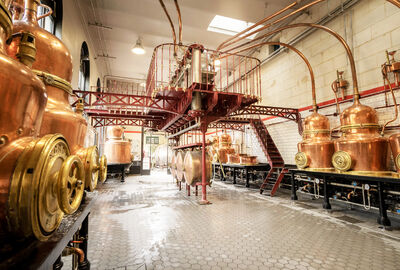
- Distilling: The wash is distilled in copper stills, usually twice in Scotland and often three times in Ireland. During distillation, the alcohol is separated from the water and other impurities, increasing the alcohol content. The first and last parts of the distillation (the "pre-run" and "post-run") are kept separate, while the middle part, is used to make whisky
- Maturation: The distilled whisky, now with a high alcohol content, is transferred to oak casks to mature. Here, the whisky develops its complex flavours and aromas. The whisky must mature for a minimum of three years, but many whiskies mature for much longer.
- Bottling: After maturation, the whisky is removed from the casks, often filtered, and bottled. Sometimes the whisky is still blended (in the case of blended whisky) or diluted with water to reach the desired alcohol content.
- Enjoyment: Now the whisky is ready to be enjoyed!
> Our ultimate guide through all the different types of whisk(e)y
Does whisky go bad?
Whisky is a strong drink with a high alcohol content, which means it has an almost unlimited shelf life. If you have a bottle of whisky that is properly sealed, you can keep it for years, even decades, without the flavour or quality deteriorating. However, the flavour can change if the whisky is exposed to light, air or temperature fluctuations. If there is too much air in the bottle relative to liquid then "oxidation" can also occur, directly affecting its flavour and intensity.
So an open bottle of whisky will often lose some of its aromas over time, but it will not "go bad".
Make sure you store your bottle in a cool, dark place and seal it well after each use, and that the bottle is always at least a quarter full (the less air there is in the bottle, the less oxidation can occur). It is best to transfer leftovers to smaller sample bottles that can be sealed well from the outside air (apothecary bottles are ideal, glass carafes are not), or you can artificially fill the original bottle with, for example, marbles to reduce the volume of air in the bottle.
> How do you store drinks correctly in summer?
> How long can you keep an opened bottle of liquor?
Does whisky make you fat?
As with all alcoholic drinks, whisky contains calories. A standard glass of whisky (about 35 ml) contains about 80 to 100 calories, depending on the alcohol content. If you drink whisky regularly, these calories can accumulate, especially if you don't take your total calorie intake into account. In addition, alcohol can increase your appetite, which can lead to extra eating and therefore weight gain. Earlier this month, we wrote an extensive blog about this. Be sure to take a look if you want to know more about this topic!
> For the calorie-conscious drinker: tips for a responsible summer
Is it whisky or whiskey?
Whether you write "whisky" or "whiskey" depends on the origin of the drink. Scots and Canadians use the term "whisky" without an "e", while Irish and Americans spell the word "whiskey" with an "e". So when talking about Scotch whiskey, you write "whisky", and for Irish whiskey you use "whiskey".
> The world of whisk(e)y for beginners
Is whisky Scottish or Irish?
Both Scotland and Ireland claim the origins of whisky, and both countries have a rich history of distilling it. The earliest written mention of whisky comes from Ireland, from the 12th century. But Scotland has brought the art of whisky making to perfection and today is famous worldwide for its whiskies. Ultimately, whisky is both Scottish and Irish, each with its own unique traditions and flavours.
Is whisky healthier than beer?
Whisky has a higher alcohol content and fewer calories per glass than beer, but that does not necessarily make it healthier. Moderate drinking, whether whiskey or beer, can have some health benefits, such as a lower risk of cardiovascular disease. But if you drink too much, the health consequences can be serious, such as a higher risk of liver problems, cancer and addiction. The important thing is to enjoy in moderation, whatever beverage you prefer. What exactly about calories in spirits? For that, we would like to refer you to our blog for the calorie-conscious drinker.
> For the calorie-conscious drinker: tips for a responsible summer
Does whisky help against colds?
The idea that whisky helps against colds is an old home remedy, often in the form of a "hot toddy", a warm mix of whisky, honey, lemon and spices. Although whisky can temporarily soothe the symptoms of a cold, such as a sore throat or stuffy nose, it is not a cure. The alcohol in whisky can make you feel warm, and the honey and lemon can soothe your throat, but it does not replace what you really need: rest, adequate drinking and a healthy diet.
> Discover 7 surprising health benefits of whisky here
Is whisky bad for your teeth?
Whisky, like all other alcoholic drinks, can have an impact on your teeth if you enjoy it regularly. Alcohol dries out your mouth, leaving less saliva to protect your teeth from harmful bacteria. Moreover, alcohol is acidic, which can damage your tooth enamel. If you drink a glass of whisky, it is smart to drink some water afterwards to rinse your mouth and protect your teeth. As with anything, it is important to enjoy in moderation to limit the negative effects.
What is the most drunk whisky in the world?
Johnnie Walker Red Label has been the most drunk and processed whiskey in the world for years. The marketing around and affordability of this reference play a very big role in its success.
Which whiskey is a good investment?
It is one of the most frequently asked and at the same time the most difficult question we get asked in. After all, everyone is looking for the "next big thing". Unfortunately, we don't have a crystal ball either and it is almost impossible for us to predict which references will go "hard" with aficionados and collectors.
Of course, we always try to make an estimate. If you are looking for a bottle as an investment, the references we refer to as "Collector" are often a good choice. However, it is no guarantee of success, so for that reason always keep Jan Broekmans' own advice in mind: don't buy whisky as an investment that you would never want to drink yourself. If the price doesn't go up, at least you'll still have the pleasure of drinking them yourself.
> You can find a list of our collectors here.
What is the most expensive whisky?
Which whisky is the most expensive is a question that is difficult to answer. After all, prices depend on many things, including, for example, the age of the spirit, bottling years, any cult status of an old or closed distillery and scarcity on the market. In addition, prices are also often driven up by auctions and second-hand resales from speculators or investors.
Speaking of auctions, as recently as 2023, a rare Macallan 1926 changed hands at Sotheby's for the hallucinatory sum of €2.4 million. This made it the most expensive bottle of single malt ever sold at auction at the time. A similar bottle was also auctioned once before in 2019: at that time, it brought €1.7 million. They were part of a series of 40 bottles from 1986 that were never officially sold, but were offered by Macallan to their then most important customers.
In our shop, the most expensive reference you can buy at the time of writing is the Johnnie Walker x Jenson Button Signature Blend worth a whopping 45000 euros. This makes it the most expensive bottling in our range, even higher than the imaginative Karuizawa's
How strong is whisky?
When people talk about the "strength" of liquor, they usually mean its alcohol content (ABV).
Whisky is a regulated product, meaning that a number of conditions must be met before the final product can be called "whisky". One of the rules is the minimum alcohol content: in the EU (including Scotch and Irish whiskey), the US and Canada, whisky must contain a minimum of 40% alcohol by volume to be called whisky.
Many standard bottlings are around 40-43%, some quality or "non-chill filtered" releases choose 46% ABV. In the US, bourbon and rye are also common at 45-50% ABV (e.g. Bottled-in-Bond at 50%). In Japan, 40-43% is common. "Cask strength" or "barrel proof" whiskies are bottled undiluted and are therefore higher in strength: usually between about 50% and 65%. Regional exceptions exist, such as India where many whiskies are bottled around 42.8% ABV,
For average commercial whiskies, 40-46% is the normal range, and you will find most whiskies within that range.
You may also have seen "proof" written on bottles, for example "100 proof". It is an alternative way of indicating the strength of whisky and is only used in the US today. The formula is thankfully simple; the "proof" value is actually double the alcohol content (ABV). In other words, a bottle of "100 proof" corresponds to 50% alcohol.
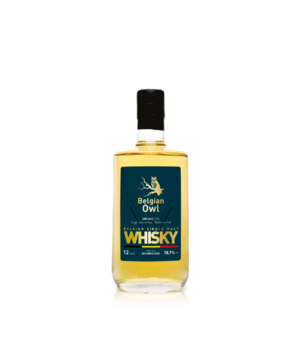
Our most punishing bottle at the time of writing is the Belgian Owl 12y, with an alcohol content of more than 78 per cent!
Bonus round: do you already know the answer to these questions?
> Do you drink whisky with or without ice?
> How is a perfect Irish coffee made?
> What are the 10 most purchased whiskies?
> Do you recognise these Scottish whisky regions on the map?
> Do you know these 10 famous whisky logos ?
> What are independent whisky bottlers?
> Which cigars go with whisky?
> What are the hidden benefits of a glass of whisky?
> What influence do wine casks have on whisky?
> What influence do sherry casks have on whisky?

Marketing • Blogger
As a creative jack-of-all-trades in the marketing world, I also bring that imaginative flair to my drink choices. Whether on a night out, sunny vacation or social gathering with girlfriends, I'm always in my element with a refreshing cocktail in hand. Cocktails have stolen my heart because of the endless possibilities to experiment and explore. My favorite cocktail of the moment is the "Lazy Red Cheeks"! A delicious cocktail using vodka as a base. I love vodka because it mixes perfectly with non-alcoholic drinks. My favorite spirit? Rum!